
Belly flaps

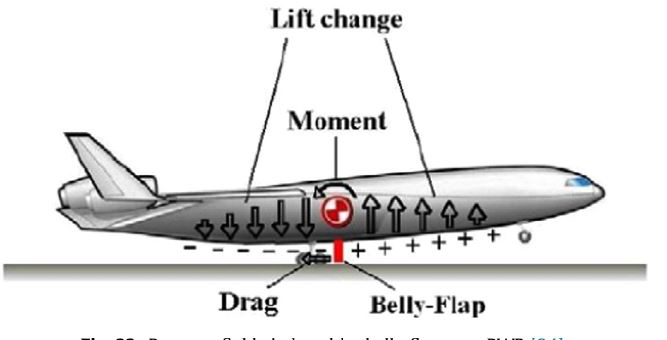
 Belly flaps are one of the esential control surfaces in a BWB design. This developes a separation of pressure during take off which helps the aircraft to produce a desired pitching moment. as the aircraft takes on momentum the air undert the wind, in this case the whole aircraft produces lift and produces a nose up moment ( desired) to help with this pitching moment, belly flaps are deployed, this produces a separation of the high pressure air from reaching the aft of the aircraft and this further helping this nose up pitching moment. This is an important part of a BWB design because the BWB design doesnt have a tailplane ( elevator to produce high moment for pitching).
Comments

Popular posts from this blog

PT6A-27

General Engine specification Blog1. It is a turboprop engine- free turbine . This is an engine used in airplanes like DHC-6 Twin Otter 300  Harbin Y-12 Beechcraft This a Pratt and Whitney Canada Engine. One of the most famous and successful company to produce turboprop engine. Compressor  It consist of 3 stage axial compressor and 1 stage centrifugal flow compressor. Combustion  Annular reverse flow (right to left according to diagram above) combustion with 14 simplex burner (Glow plugs) Turbine 1 stage free power turbine and 1 sage gas generator power turbine.(Left to right according to diagram above) Other specs: Fuel type: aviation kerosine Overall pressure ratio- 6.3:1 Air mass flow: 5.3 lb/s Power to weight ration: 2.14 hp/lb 

Thrust Reversal

Thrust Reversal consist of 2 words. Thrust and reversal. This is a process adopted to reduce the aircraft velocity during landing. It is a type of braking system. The braking system in an aircraft consist of: 1. Landing Gear brakes. 2. Ground Spoilers 3. Thrust reversal. So while talking about the thrust reversal, the type of aircraft has an important role to play. For the propeller driven aircraft  the reverse thrust is achieved with the appropriate change in the blade angle. However for a jet engine the reversal of the thrust come in basically 2 major types: 1. Reversal by the use of hot exhaust. 2. Reversal by the use of cold bypass air. Classification in terms of mechanism used are: 1. Target (bucket) type  Operated With hydraulics in turbojet engine 2. Clamshell (Cascade) type  Operated with Pneumatics in Low bypass turbofan engine 3. Coldstream type The cold stream reverser system is activated by an air motor in High bypass turbofan engine ...

Understanding DO 178C (Safety critical avionics software)

DO-178C (Document for Operational) What Is DO-178C? DO-178C , officially titled “Software Considerations in Airborne Systems and Equipment Certification,” is a set of guidelines published by RTCA (U.S.) and EUROCAE (Europe). It provides a rigorous framework to plan, develop, test, and certify software used in aircraft systems , ensuring that the software is both safe and compliant with regulatory requirements. It is widely accepted by FAA , EASA , and other aviation authorities worldwide. Why DO-178C Is Important Airborne software can impact human lives . Whether it’s controlling engine thrust, displaying flight routes, or automating cabin pressure, a software error could have catastrophic consequences . DO-178C ensures: Safety-critical systems behave predictably Software is free from unintended behavior Traceability exists between requirements, code, and tests Key Principles of DO-178C 1. Software Levels (DAL – Design Assurance Levels) The stringency of testing and proce...